
Unveiling the Secrets of Ultra-Light Carbon Fiber MTB Rims
How Ultra-Light Carbon MTB Rims Cut Weight | Light Travel
Spoke holes: molded, not drilled
Here's something most riders never think about. The traditional way to make a carbon rim is to cure a complete hoop, then drill the spoke holes through it. Every one of those holes severs fibers that have already done their job curing — the strongest part of the laminate gets cut at exactly the points that carry the most load.
We don't drill. Our spoke holes are formed in the mold itself, so the fibers flow around each hole continuously, and we add local reinforcement right where the nipple sits.
Does it actually make a difference? We pulled nipples out of rims until something broke. The spokes snapped — every time — while the molded holes held past 300 kgf (about 2,940 N). When the weakest link in your wheel is the spoke and not the rim, you've done something right. It doesn't make rim failure at the spoke bed impossible; it makes it the last thing to worry about.
 Spoke hole tensile test at the Light Travel Cycling lab, carbon spoke hole withstanding 300kgf load
There's a second benefit that shows up years later. A seated nipple rests in a fully wrapped carbon pocket, so load spreads across a broad contact area instead of concentrating on a drilled edge. And because hole angles are set in the tooling, spokes, nipples and holes end up in one straight line after building — no lateral torque, no strange wear patterns, a wheel that stays true longer.
The carbon itself: why we blend instead of chasing one "best" fiber
Toray's T700 and T800 are the workhorse fibers in our standard MTB rims. T800 is stiffer, which lets you build lighter for the same stiffness — but push a pure thin-ply T800 layup too far and the rim gets harsh, then brittle.
And here's the myth worth killing: T700S, T800S, T1100G — their elongation at break is 2.1%, 2.0%, 2.2%. Practically identical. When a cheap "ultralight" rim turns brittle, the fiber almost never did it. The thin layup and the resin system did. Blaming the fiber is like blaming the flour when the baker skimps on the recipe.
So our Flyweight rims blend fibers instead of betting on one: T1000 and T1100G where grams buy the most strength, with three techniques doing the quiet work
· Reinforcement only where stress concentrates — the spoke beds get extra plies, nothing else does
· Stepped overlaps — plies stagger instead of stacking, which trims the hidden weight of doubled layers
· Thin plies, used deliberately — tuning thickness zone by zone rather than uniformly
T1100G is aerospace-grade material with an aerospace-grade price and a narrow processing window, so we don't build whole rims from it. It goes into local patches and stress-critical zones — exactly where one gram of it earns the most. If someone tells you their rim is "full T1100," ask them why they're spending money where it buys nothing.
Toughness: light doesn't have to mean fragile
The most common objection to ultralight rims is also the fairest one. This is where our materials budget goes.
In MTB production we weave a high-tensile fabric into the rim's key stress areas. Same weight, same geometry, same lab impact test as our standard layup: average impact resistance up 20%, and up 43% on our Enduro-grade rims.
Those are measured numbers from our own bench, and we're happy to be boring about them: same test, same rig, only the fabric changed. We'd rather show you a 20% that survives scrutiny than a 200% that doesn't.
For our flagship ultra-light builds we pair Toray T1100G prepreg with a resin system formulated in-house — elasticity, inter-ply bonding and strength tuned for where the rim will actually be ridden. You can see the results in the builds that need it most: the DH-30 downhill rim and the Enduro line.
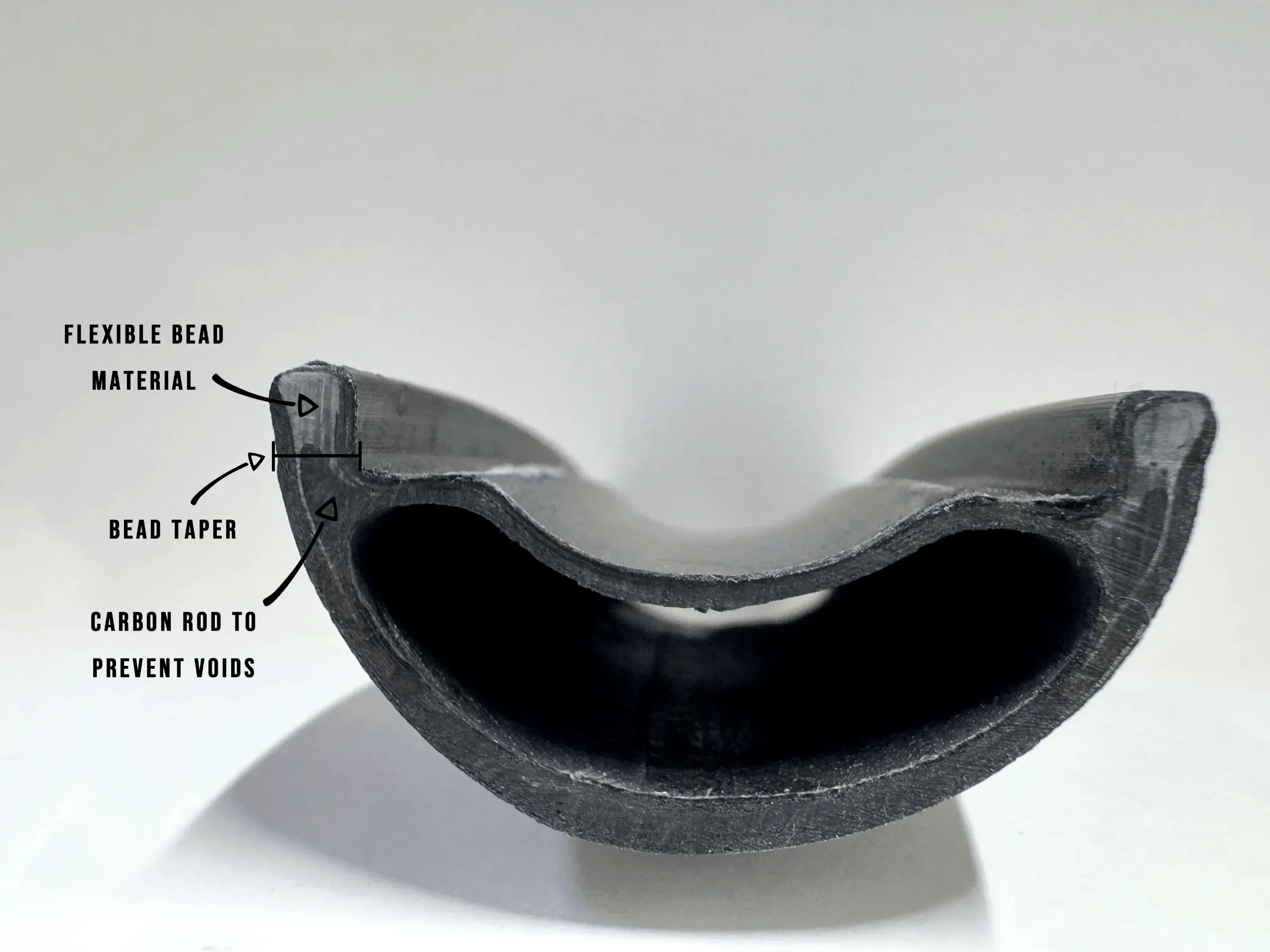
Different scenarios get different reinforcement. On Enduro and DH rims, extra T1100G wrapping lands on the stress zones and the sidewalls get thickened for the G-forces of flat landings. The cutaway below shows exactly where — the marked zones aren't decoration, they're the difference between a rim that survives a bike-park season and one that doesn't.
 light-travel-cycling-dh30-carbon-downhill-rims
Questions we actually get asked
T700, T800, T1100G — which should I choose?
You shouldn't have to. That's our job, and it's already baked into the versions: Standard rims run mainly T700/T800, Flyweight rims bring in T1100G where it pays. If you want the one-line version — T700 is the value all-rounder, T800 is stiffer-per-gram, T1100G is the flagship we spend like a scalpel, not a paintbrush. Pick your version; the fiber engineering is done.
Aren't ultralight rims fragile?
We'd worry too, if we hadn't spent years on exactly this. The fragile ultralight rims of the past were thin layups on cheap resin — the fiber was never the villain. With the high-tensile fabric and targeted reinforcement described above, our rims take a measured 20% (up to 43% on Enduro) more impact than our own standard baseline at equal weight. Every rim also goes through lab impact testing and real riding before it ships. Fragile isn't a weight class; it's a design failure.
Tubeless compatible?
Yes, and here the molding method gives us something drilling can't: because the spoke holes are formed — not drilled — the rim bed needs no access holes at all. That means a one-piece seamless tubeless bed: mount tubeless without rim tape, better airtightness, a few more grams saved. Run sealant anyway off-road; it seals the micro-gaps and shrugs off thorns. Spares here if you're building your own.
Customization?
Width, height, weight version, finish, hub and spoke spec — yes. One honest caveat: spoke-hole angles are set in the tooling, so fully bespoke drilling angles or cross-sections make sense at volume, where a dedicated mold pays for itself. For smaller orders our engineers will steer you to the smartest configuration rather than the most expensive one. Volume builds are OEM/ODM territory.
Related: XC ultralight wheelsets | Hookless vs hooked rims | More rim technology from the factory
