
Hookless vs Hooked Rims: Safety, Pressure Limits (2026) – Light Travel Cycling
Hookless vs. Hooked Carbon Rims: The Complete Comparison & Buying Guide
Quick answer: Hooked rims lock the tire bead mechanically — they accept nearly any tire and high pressures. Hookless rims (TSS standard) rely on air pressure and a tight fit — lighter and more impact-resistant, but strictly limited to ≤72.5 psi on road and certified hookless tires only. Road racer on narrow tires: hooked. Gravel, XC and wide-tire road: hookless works beautifully — if you follow the rules.
This guide details structural differences, pressure limits, tire compatibility, safety performance, and suitable applications to help you make the right choice for road, gravel, and MTB. It is intended for mechanics, DIY builders, and procurement professionals. It comes from a factory that manufactures both designs — we build hooked and hookless rims every day and ship them worldwide.
1. What Is Carbon fiber Rim Hook? Basic Design Principles
· Hooked rims (clincher-type): feature a distinct hooked flange. The tire bead locks onto this hook, creating a mechanical interlock.
· Hookless rims (Tubeless Straight-Side, TSS): a smooth inner wall without a raised lip. The bead is held solely by air pressure and a tight interference fit.
This structural difference directly dictates maximum tire pressure, tire compatibility, weight, and impact resistance. Hookless designs strictly follow the ETRTO TSS standard to ensure safe compatibility.
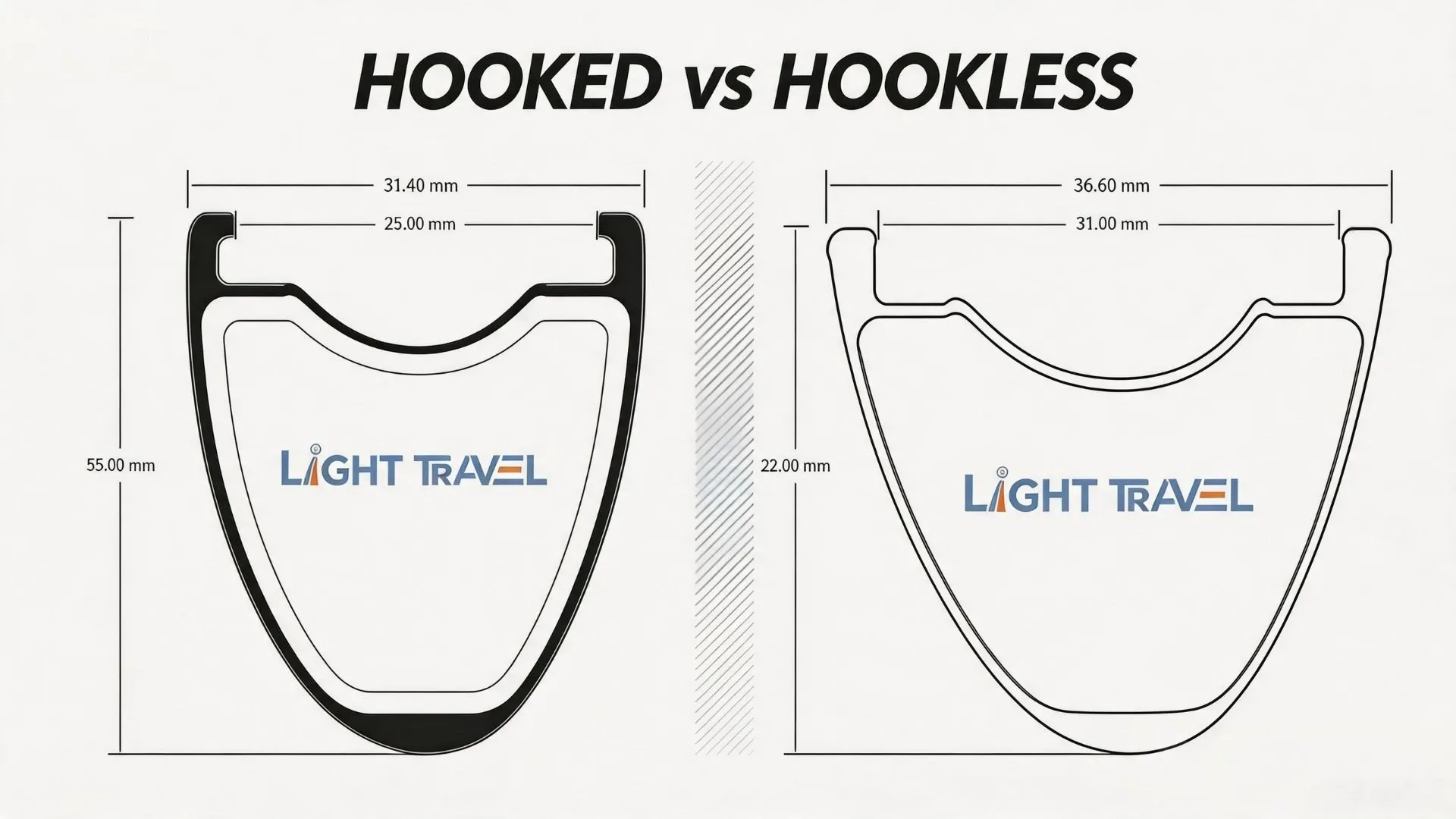 Diagram-comparing-hooked-and-hookless-rim-cross-sections
2. Hooked Rims Full Explained
A classic, mature design used for decades, fully ETRTO-compliant. Widely used on road, commuter, and most mountain bikes.
Advantages
· Broad tire compatibility: mounts traditional clincher tires (with tubes) and most tubeless-ready tires.
· Wide pressure range: from low-pressure off-road to high-pressure road racing.
· High tolerance: more forgiving of tire-rim mismatches, with relatively lower safety risk.
· Easy servicing: familiar to every bike shop.
Disadvantages
· Slightly heavier from the added hook material — though modern carbon manufacturing has narrowed this to 10–30 grams, negligible in practice.
· Potential stress concentration at the hook base, which may crack under severe impact (modern layup designs have greatly improved this).
Best for
High-speed road riding and racing; riders wanting tire-choice freedom or pressures above 70 psi.
3. Hookless Rims Fully Explained (Including Hybrid Designs)
Structural features
Originating from mountain bike tubeless innovation in the 2000s — designed to cut weight and eliminate stress cracks — now expanded into gravel and wide-tire road wheels. The inner wall is smooth; the bead is held by air pressure and interference fit.
Note: "mini-hook" or "hybrid" rims also exist — a very shallow lip between pure hookless and hooked, aiming to combine low-pressure stability with light mechanical locking. Market share is currently small, and manufacturer pressure/compatibility rules still apply.
Advantages
Lightweight: eliminating the hook saves 10–30 grams.
Uniform stress distribution: no stress concentration points — excellent impact and fracture resistance.
Easy tubeless installation and excellent airtightness.
Stable low-pressure handling on sand, mud, and rock.
Disadvantages (the key constraints)
Strict pressure limits (ETRTO TSS): MTB/gravel hookless rims (inner width ≥30mm): max ≤45 psi. Road hookless rims (28c tires and wider): max ≤72.5 psi (5 bar). Exceeding the limit can cause sudden bead detachment — extremely dangerous. Some proprietary brand systems are tested higher; always follow the rim manufacturer's stated limit.
Dedicated tire requirement: only tubeless tires labeled "Hookless Compatible" / "Hookless-ready" / ETRTO TSS-compliant. Traditional clincher tires are strictly forbidden on carbon hookless rims. Hookless-compatible tubeless tires may be used with inner tubes only where both rim and tire manufacturers explicitly allow it. A few aluminum hookless rims accept specific clinchers at ≤35 psi under explicit approval — rare; check the manual.
Best for
Gravel, cyclocross, XC/Enduro/DH; riders prioritizing light weight and low-pressure comfort who follow the "certified tire + low pressure" rule.
4. Quick Comparison Table: Hooked vs. Hookless
Feature | Hooked Rims | Hookless Rims |
Structure | Inner hooked flange | Smooth inner wall (TSS standard) |
Tire compatibility | Clinchers with tubes; most tubeless tires | Only hookless-compatible/TSS-certified tubeless tires (tubes only per manufacturer) |
Max pressure | Road: 60–120 psi; MTB/gravel: 50–80 psi | MTB/gravel: ≤40–45 psi; Road: ≤72.5 psi (5 bar) |
Impact resistance | Good (potential stress at hook base) | Excellent (no stress concentration) |
Tubeless installation | Possible; often needs a blast pump | Very easy; excellent airtightness |
Safety reminder | Avoid over-inflation | Never exceed pressure limits; never use non-compatible tires |
5. Safety Warnings and Common Misconceptions
Critical safety warnings
Carbon hookless rims absolutely forbid traditional clincher tires (with or without tubes) — no mechanical lock means the bead can detach in hard corners or at pressure.
Never exceed the stated pressure — hooked or hookless, over-pressurization causes blowouts or rim damage.
Prioritize ETRTO/ISO-compliant rim and tire combinations.
Common misconceptions
"Higher pressure on hookless is faster." False — the limit is a physical safety boundary, and lower pressure often rolls faster off-road.
"An inner tube makes clincher tires safe on hookless." False — a tube provides no lateral locking; the bead still detaches.
"Hooked is better at everything." False — hookless wins in low-pressure MTB/gravel scenarios.
"Impact-resistant means unbreakable." Not exactly — it means the structure resists cracking; it is not a license to hit things.
6. Frequently Asked Questions
Not on carbon hookless rims — absolutely forbidden. Only rare aluminum hookless rims with explicit approval, at ≤35 psi. Safety first: use certified hookless tires only.
Do hookless pressure limits make you slower?
No — at proper low pressures, off-road rolling resistance drops and grip rises. On road, quality hookless tires at ≤72.5 psi roll as well as anything. If you need >70 psi on narrow tires, choose hooked.
How do I identify hookless-compatible tires?
Look for "Hookless Compatible", "Tubeless Straight Side", "TSS", or ETRTO compliance on the sidewall or packaging.
Can I run 45 psi on hookless gravel rims?
Only on rims with ≥30mm internal width where the manufacturer allows it. Standard guidance is ≤40 psi. Regularly above 45? Choose hooked rims.
Can hookless rims take very wide tires?
Yes — with certified hookless tires, within the manufacturer's max width per the ETRTO chart. Check your pairing in our rim width and tire size guide.
Which does Light Travel Cycling recommend?
We build both. Our rule of thumb: road racing on 28c and under with high pressure — hooked. Gravel, XC, and wide-tire road at moderate pressures — hookless. Every rim we ship follows ETRTO standards and passes 18 safety tests before leaving the factory. Browse all carbon rims and wheelsets.
Conclusion
Hooked rims: mechanical locking for high pressures and broad tire choice — road racing and maximum flexibility.
Hookless rims: air-pressure retention with clear pressure and tire rules — gravel, MTB, low-pressure comfort, and weight saving.
Either way: always follow the rim and tire manufacturers' official pressure and compatibility documentation — never guess.
Related reading: Rim finish and weave explained | Carbon wheels by size | How to choose a carbon rim
