
Molded-In vs Drilled Spoke Holes: What 350kgf of Pull-Out Data Shows – Light Travel Cycling
Molded-In vs Post-Drilled Spoke Holes on Carbon Rims: The Full Technical Breakdown
Every spoke on your wheel pulls on the rim about a hundred times a minute, thousands of times per ride. All of that load funnels through one of the smallest features on the whole wheel: the spoke hole. Which is why the way a manufacturer makes those holes — cut them after curing, or form them in the mold — quietly decides how light, how strong, and how long-lived a carbon rim can be.
We build rims both ways, so we'll try to be fair to both. But we also pull nipples out of rims for a living, and the numbers aren't subtle. Here's how the two processes actually differ, and what the differences buy you.
The core difference: when the hole happens
Molded-in spoke holes are formed during lay-up and curing — mould features create the openings, and the rim comes out of the press with its holes already done, fibres flowing continuously around each one. Post-drilled holes are machined afterward: the rim cures as a solid hoop, then a CNC cuts the openings through cured laminate.
That timing is the whole story. Cutting carbon after it has cured severs fibres that were doing their job; forming the hole before curing lets those same fibres wrap around the opening and keep working. Everything else in this article — strength, weight, fatigue life, cost — follows from that single difference.
What molded-in holes buy you
Stronger holes, measured
Drilling a cured rim cuts fibres and invites micro-cracks and delamination around the cut. Research puts the strength penalty of a defective drilled hole at around 11%. Molded-in holes skip the cutting entirely: continuous fibre around the opening, no machining damage, better resistance to both impact and the cyclic loads of real riding.
Our own bench tells the same story. In pull-out testing, our molded-in holes hold over 350 kgf — and in most destructive tests it's the spoke that snaps, not the rim. When the spoke is the weakest link in a wheel, the spoke hole never gets to be the reason a ride ends. The comparison against drilled rims is on the order of 30% higher pull-out strength.
Lighter at the same size — here are the actual numbers
A drilled rim has to pay for its holes twice: once in cut fibres, again in the extra reinforcement plies needed to patch each one. Patent literature is candid about this — manufacturers add plies around drilled holes, the plies add weight, and they still don't fully stop the micro-cracks. Molded-in holes don't need the patch.
We can show this with our own two product lines, because they're the same rim in two processes: the GR/R series (molded-in) runs 320 g at 45mm depth and 335 g at 50mm in Flyweight trim, while the AR series (post-drilled) comes in at 345 g and 355 g for the same depths. Same factory, same fibres, same profiles — the 25-30 gram difference is the drilling tax.
Nipples that sit properly
The mold forms a contoured seat that matches the nipple's shape, so tension spreads across a real contact patch instead of a sharp edge pressing on one spot. Our seats are conical, which also lets the nipple articulate a fraction of a degree — small motion, but it's the difference between a joint that relaxes and one that work-hardens. On a flat drilled hole, the nipple's edge corners do the bearing. Carbon does not enjoy being pinched by corners.
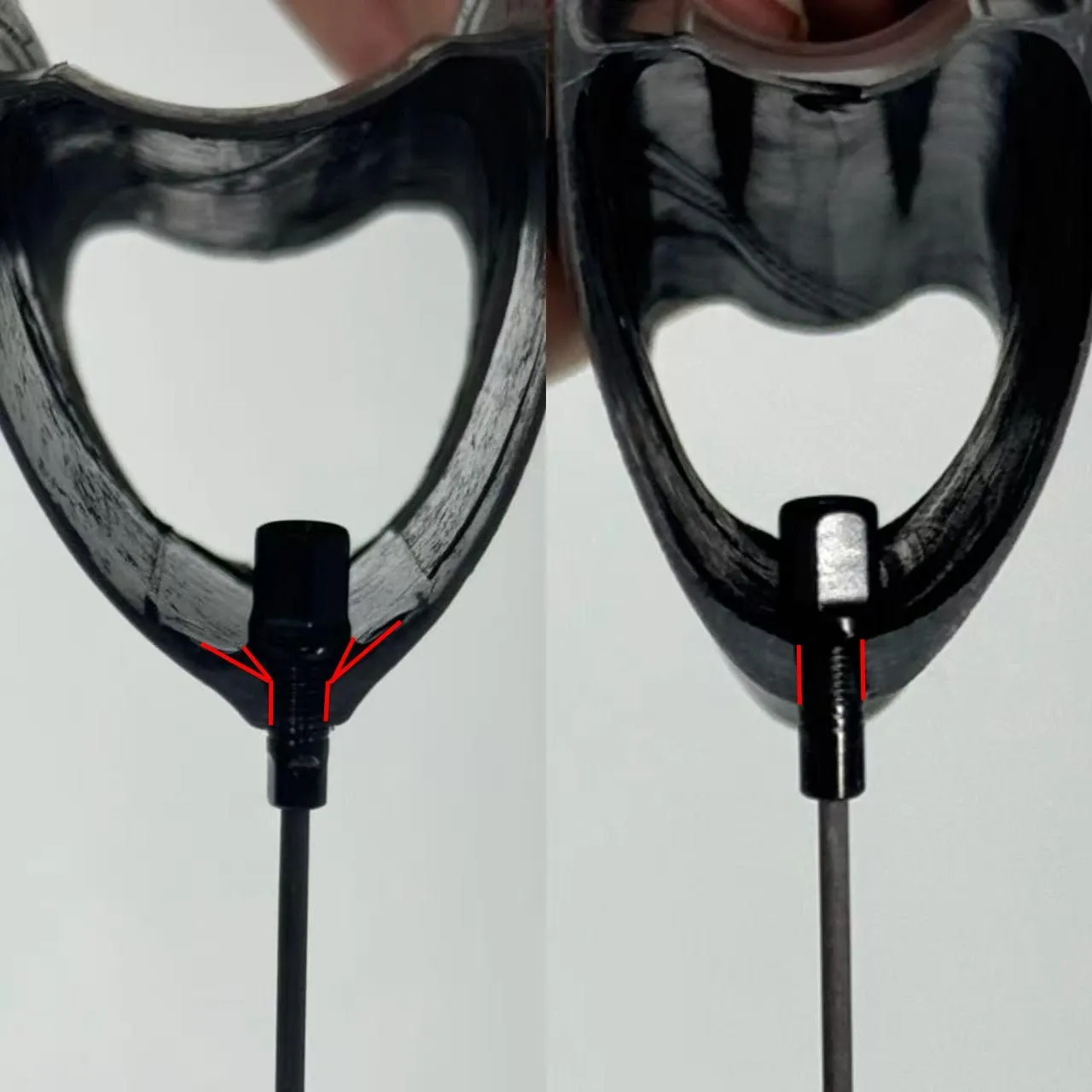 Conical-nipple-seat-on-a-molded-in-carbon-spoke-hole-full-contact-fit
Straight-line spoke loading
Hole angles are engineered into the tooling to match hub flange geometry and lacing pattern. Built wheels end up with spokes loading straight through the nipple seat — no bending stress, fewer broken spokes, less truing drift over the years. Drilled rims depend on CNC positioning for their angles; deviations tilt the nipple and bend the spoke.
Smoother stress, longer life
Reinforcement patches on drilled rims create thickness steps, and thickness steps are where cracks like to start under repeated load. Molded-in rims graduate wall thickness smoothly with no local patching — a more even stress map. FEA studies single out spoke-hole stress concentration as one of the most critical factors in rim fatigue life; geometry-driven stress peaks are what quietly kill composite structures.
In fairness: what drilling does well
Post-drilling isn't a corner cut — it's a legitimate engineering trade. One blank mold serves every hole count; if a customer wants 24H today and 32H next month, the CNC just... drills differently. Mold investment stays low, and the process is mature everywhere. For brands running many SKUs at modest volumes, that flexibility is worth real money.
And to be clear: a properly reinforced drilled rim from a competent factory meets safety standards. The reinforcement works. It's just compensating for damage that molding never creates in the first place — a patched wall versus one that was never broken.
You're in good company
Molded-in spoke holes aren't our invention, and we like it that way — the technology has been validated at the top of the industry. ENVE Composites holds the foundational patent (US 8,313,155) and builds molded-in holes into rims like the Foundation AM30. Duke Racing's SpokeCore moulds spoke-hole geometry directly into the laminate. And our own version pairs the molded holes with blended T700/T800/T1000 layups — the full layup story is in our ultra-light rim article.
Why molded-in rims cost more — honestly
Three real reasons, no mystery:
· Mould math. A molded-in tool is married to one hole count. Offer 24H, 28H and 32H and you're maintaining three moulds where a drilling shop maintains one blank and a CNC program.
· A fussier process. Plies must land precisely, resin flow must be managed around the mould pins, and scrap control is harder. We live with this daily; it's the price of the structure.
· You're buying structure, not finish. The money goes into fibre continuity, graduated walls and seats that fit — none of which photographs well, all of which ride well for years.
The comparison, in one table
| Molded-In Spoke Holes | Post-Drilled Spoke Holes |
Carbon fibre | Continuous fibres wrap each opening | Local fibres cut by machining |
Weight (same spec) | No patch plies needed — lighter (GR/R 45mm: 320g) | Reinforcement adds mass (AR 45mm: 345g) |
Pull-out strength | >350 kgf; spokes usually break first | Depends on reinforcement quality |
Nipple seating | Contoured full-contact seat | Flat hole; edge point-loading |
Spoke angle | Engineered in tooling; straight-line load | CNC-dependent; deviation risk |
Stress distribution | Graduated, even | Thickness steps concentrate stress |
Mould investment | One mould per hole count | One blank mould, any hole count |
Production cost | Higher — complex process | Lower — mature and simple |
Track record | ENVE, Duke Racing, Light Travel Cycling | Industry-wide default |
Where this is heading
The industry's direction is visible from here: "cure first, machine later" is giving way to "form it right the first time", and the spoke hole — the most loaded square centimeter on a rim — is where that shift shows up first. Both processes will keep making safe wheels. But if you're deciding where to spend on a premium build, know that the difference between a molded-in rim and a drilled one isn't marketing gloss. It's whether the strongest part of your laminate was ever cut.
Want to see the molded-in holes under your own torque wrench? Rims-only builds start here — and every rim ships with the spoke tension checked before it leaves our bench. Wheelsets built on the GR/R series | Hookless vs hooked rims
