
Are Domestic Carbon Fiber Wheelsets Worth Buying? A Straight Talk from a Manufacturing Factory (With Buying Guide)
Are Domestic Carbon Fiber Wheelsets Worth Buying? A Straight Talk from a Manufacturing Factory (With Buying Guide)
If you’re considering upgrading to carbon fiber wheelsets, you’ve likely found yourself torn between “international premium brands” and “high-value domestic alternatives”—with the former carrying a brand premium of $1,500–$5,000, while the latter offers nearly identical specs at roughly half the price.
Cycling forums are divided: some champion domestic carbon wheels as the best value-for-money upgrade, while others post images of cracked rims, warning that “you get what you pay for.”
We are a factory with over a decade of R&D and manufacturing experience in bike wheels, providing OEM/ODM services for numerous mid-to-high-end brands both domestically and internationally, while also operating our own brand. Today, we aim to cut through the noise—straight from the production line and real-world test data—to help you determine: Are domestic wheelset worth it? Where do the quality differences lie? And how do you avoid dangerous low-end generics?
Executive Summary (Straight from the Carbon wheelset Production Floor)
Yes. For 90% of road, gravel, and amateur racing cyclists, high-quality domestic carbon wheels are an exceptionally cost-effective choice.
In our in-house testing, premium domestic carbon wheels achieve over 95% of the performance of international top-tier brands, at roughly half—or even less—of the price.
However, a crucial caveat: the quality gap among domestic carbon wheels is enormous. We’ve seen excellent products from peer factories, and we’ve also disassembled countless failed, unbranded wheels—they are not the same category of product. Cheap unbranded wheelsets do pose safety risks, but this is not a reflection of “made in China”—rather, it is the manufacturing standard that determines final quality.
Why Are Domestic Carbon Wheels More Affordable? Not Because of Skimping, but a Different Supply Chain Logic
Many cyclists assume “low price = low quality,” but in carbon wheel manufacturing, this equation does not hold. The significant price gap stems largely from operational cost differences, not from variations in raw carbon fiber grade.
Eliminating Brand Premium and Intermediaries
International brands invest heavily in pro team sponsorships, global marketing campaigns, and distributor networks—all of which are ultimately reflected in the retail price. In contrast, reputable Chinese factories typically sell direct or supply boutique brands, cutting out middlemen and passing factory-direct pricing to consumers.Same Raw Materials, Comparable Carbon Grades
The vast majority of mainstream carbon wheel brands globally—including some overseas names retailing above $3,000—source Toray carbon fiber from Japan and complete production in China.At our factory, our premium lines use Toray T700, T800, and T1000-grade carbon fiber and resin systems—identical to the core materials used by those expensive brands. There is no material gap.
 T700-T800-Carbon-fiber
Vertically Integrated Supply Chain
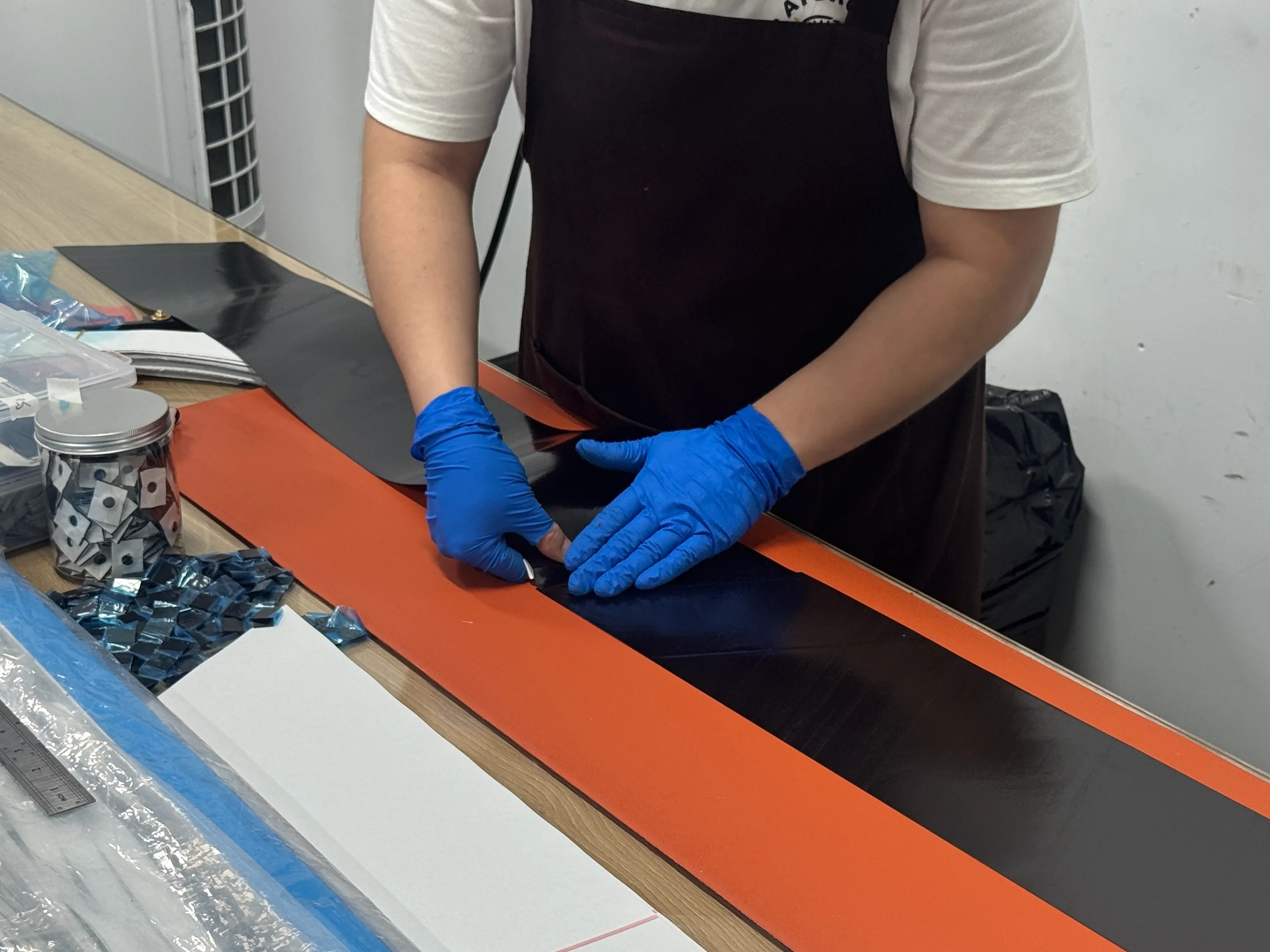
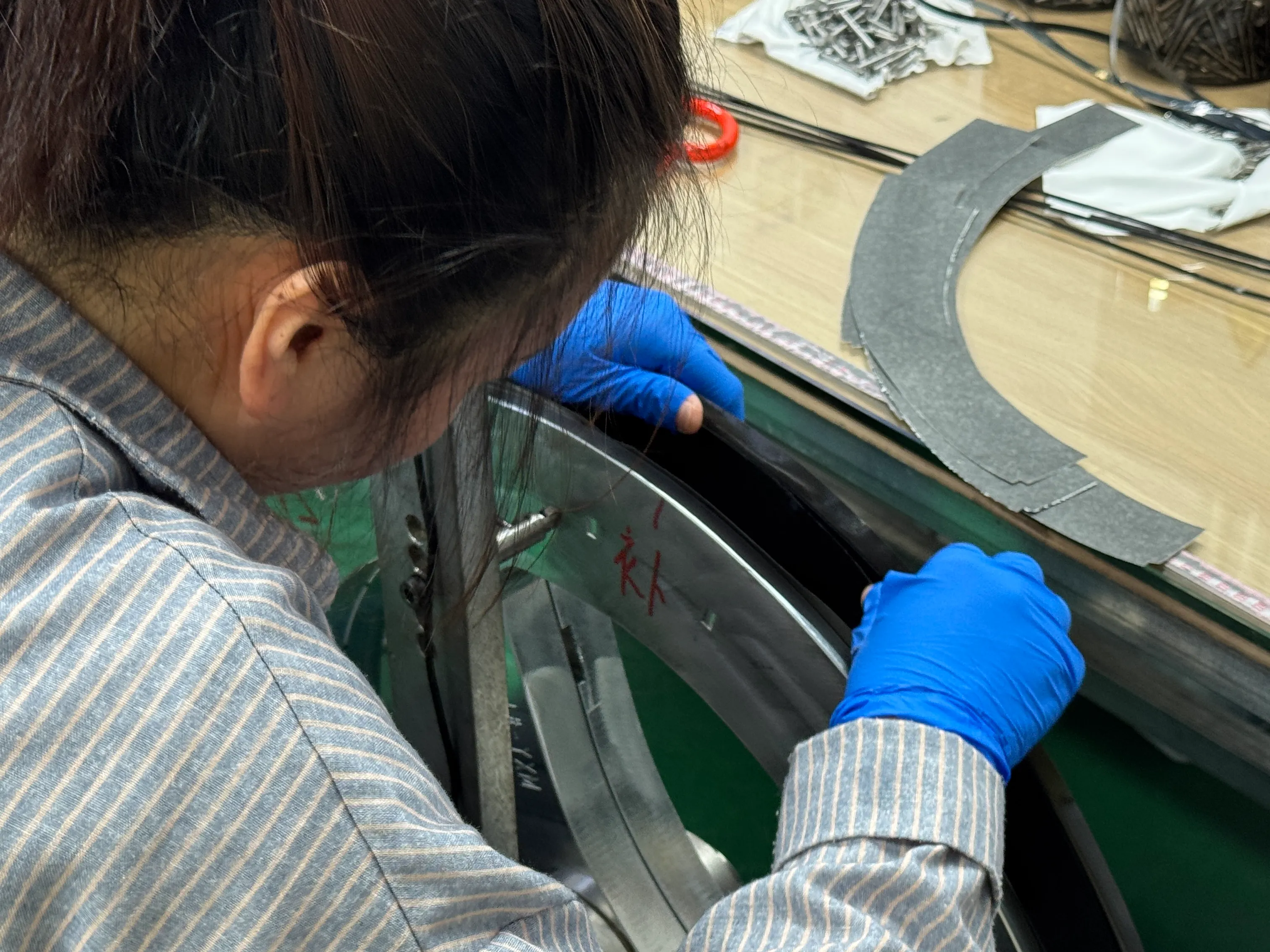
Mold development, cutting and layup design, compression molding, resin infusion, CNC machining, hub assembly, and dynamic balancing—all processes are completed in-house. No outsourcing delays, no third-party markups, resulting in significantly reduced production costs while maintaining higher quality control.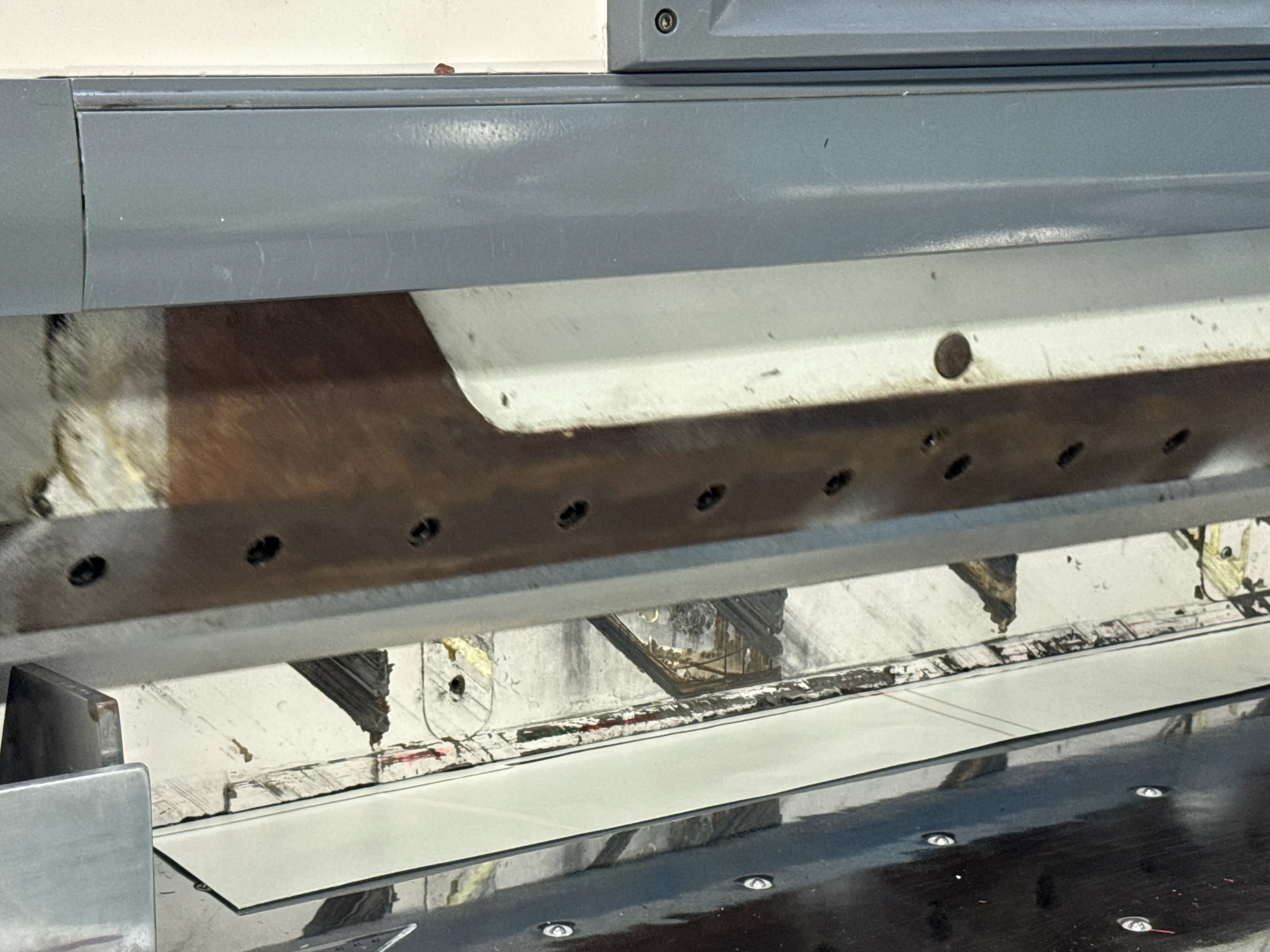 Prepreg-Cutting
 Winding
Core Distinction: Cheap Unbranded Generics vs. Certified Factory Output
What most buyers don’t know: origin does not determine quality; manufacturing standards do.
Domestic carbon wheels actually fall into two completely different tiers—lumping them together leads to the biased conclusion that “domestic = subpar.”
Tier 1: Certified Factory Output (Safe Choice)
Manufactured by established factories with over a decade of experience, serving both domestic and international brand OEM/ODM orders.
Our baseline quality standards include:
Engineered carbon layup design optimized via finite element analysis (FEA) for stiffness, impact resistance, and lateral rigidity.
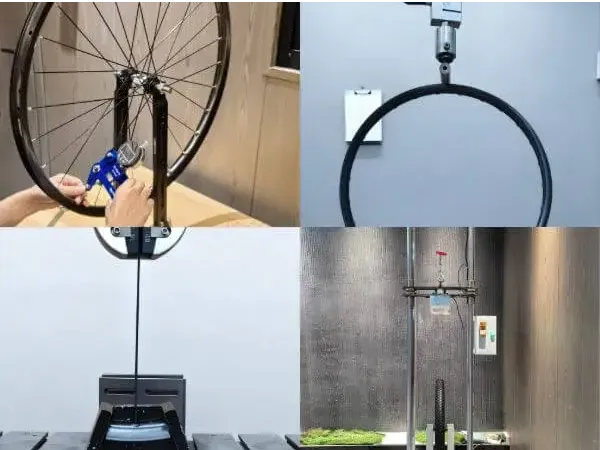
Independent impact testing: Our internal standard requires rims to withstand impacts of ≥80 Joules (industry baseline is ~40 J), with batch sampling verification.
Stable resin process: Eliminates localized resin pooling (brittleness) or resin starvation (interlayer weakness).
Precision tension and trueness calibration: Each wheel is individually checked for spoke tension uniformity and roundness, ensuring smooth rotation and minimal runout.
100% visual and dimensional inspection: Every unit is screened for micro-cracks, voids, and runout deviations before shipping.
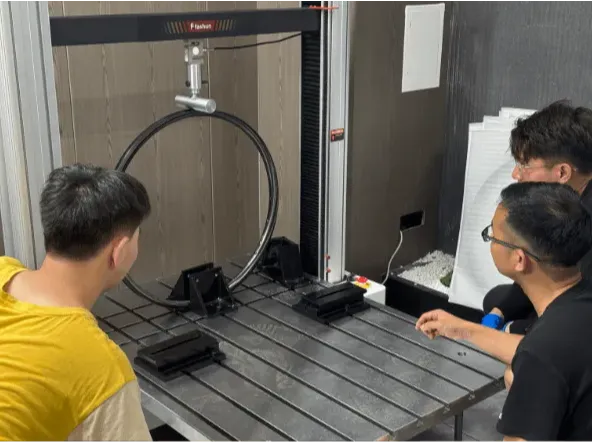 impact-resistance-test
 Conduct-comprehensive-inspections-on-wheel-sets-before-factory-dispatch
Tier 2: Cheap Unbranded Generics (Avoid at All Costs)
Priced as low as $150–$250, these come from unregulated workshops. To hit rock-bottom prices, corners are cut in invisible ways:
Use of recycled carbon waste or unclassified carbon fabric.
No engineering design; layup is done by worker intuition.
Minimal to no impact or fatigue testing.
Fitted with low-end generic hubs and chaotic spoke tension.
No QC—micro-cracks, pinholes, and molding defects are shipped as-is.
The terrifying “carbon wheel catastrophic failure” images circulating online almost exclusively come from such unbranded generics, not from established factories.
Benchmark Comparison: Certified Domestic Carbon Wheels vs. International Premium Brands
Based on our internal test data and extensive rider feedback, here’s how Tier-1 domestic carbon wheels perform:
Aerodynamics
Modern domestic rims generally adopt wide U-shaped cross-sections and hookless bead designs, achieving aerodynamic efficiency comparable to current high-end wheelsets. Third-party wind-tunnel data shows a difference of only 2–3 W at 40 km/h—imperceptible to all but pro time-trialists.
Weight
For a 50 mm deep-disc brake wheelset, certified domestic products can weigh between 1100–1300 g, on par with $2,500+ international counterparts. No weight compromise for recreational or amateur racing use.
Stiffness and Power Transfer
Optimized layup engineering delivers excellent torsional stiffness. Power loss during out-of-saddle climbing or sprinting is minimal. The marginal stiffness gains offered by premium international brands are virtually imperceptible at non-professional power outputs.
Comfort and Vibration Damping (The Most Tangible Upgrade)
A well-designed carbon layup effectively filters high-frequency road buzz, far outperforming aluminum wheelsets. Reduced hand and leg fatigue on long rides is a tangible benefit—and certified domestic products perform on par with top-tier imports.
Durability and Fatigue Life
Certified domestic carbon wheels, subjected to comprehensive testing, reliably handle rough asphalt, gravel, and daily high-intensity training. With normal use and proper maintenance, fatigue life is comparable to mid-range international brands.
Three Real Shortcomings to Acknowledge Before Buying Domestic Carbon Wheels
No product is perfect; choosing domestic carbon wheels means accepting these reasonable trade-offs:
Fewer Third-Party Pro-Level Certifications
International brands invest heavily in UCI certification and extreme-condition third-party testing. Most domestic factories rely primarily on internal standards (e.g., we strictly follow ISO 5775-2 and EN test protocols with detailed reports); some of our products do hold UCI certification, but not every model carries the pro-race label. We provide full internal test data on our product pages for transparency.
After-Sales Support Timeliness Differs from Local Distributors
International brands offer convenient in-store replacement via regional distributors. Domestic brands typically handle after-sales via email, which may involve slightly longer processing times. However, we offer clear warranty terms (e.g., 5-year structural warranty) and commit to response timelines—actual service quality is competitive.
Lower Second-Hand Resale Value
Premium brands retain higher resale value due to brand equity; domestic carbon wheels depreciate faster. However, given the upfront cost is half or less, the absolute depreciation loss is actually smaller—a minor concern for self-use owners.
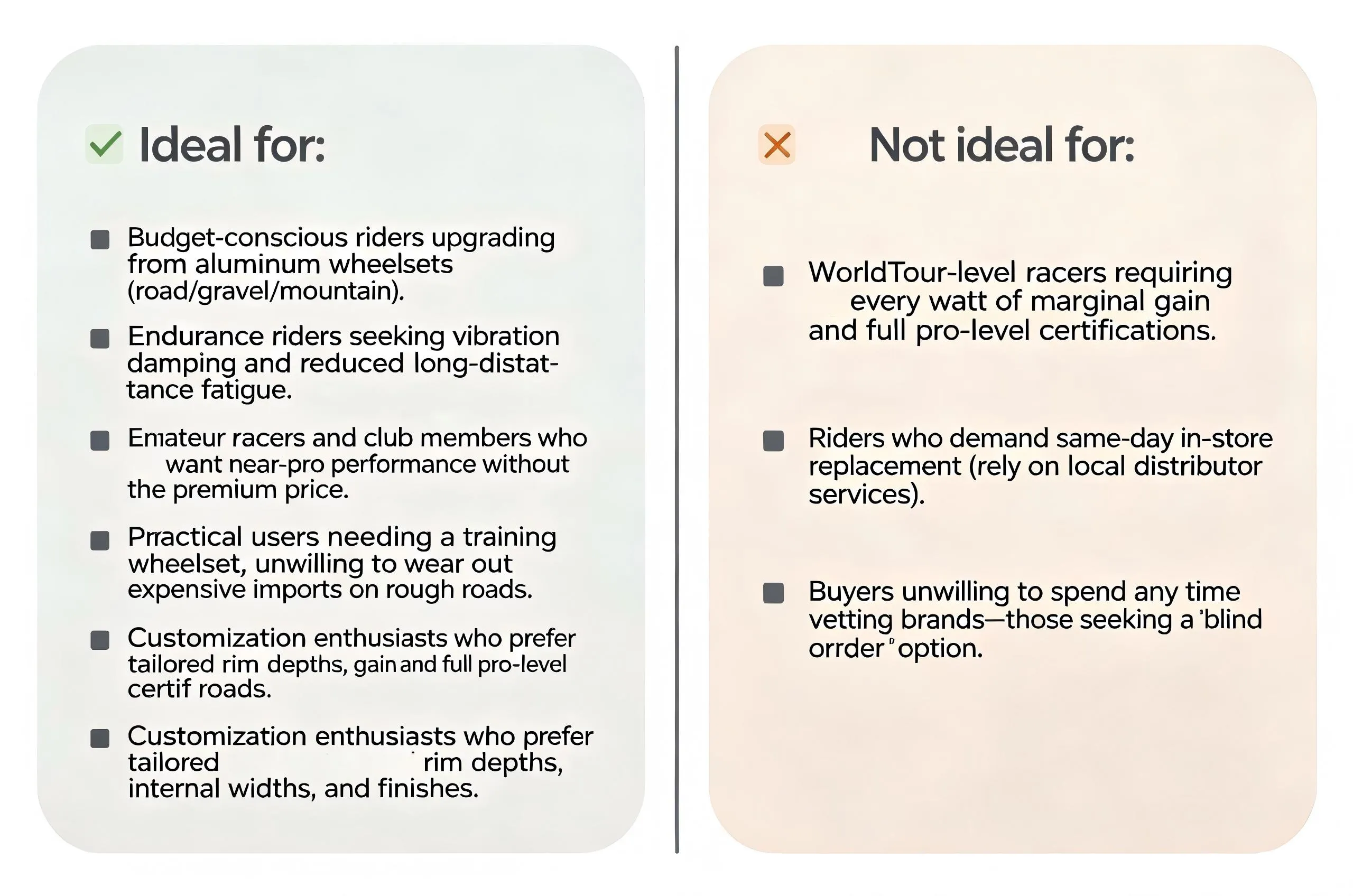
Who Should Buy Certified Domestic Carbon Wheels? Who Shouldn’t?
 Who-Should-Buy-Certified-Domestic-Carbon-Wheels-Who-Shouldn-t
4 Hard-Hitting Selection Criteria from the Factory to Avoid Substandard Carbon Wheels
Follow these principles to ensure a reliable purchase:
Never buy unbranded “white-label” wheelsets with no public test data or verifiable user feedback—skip them immediately.
Prioritize factory-direct brands that disclose impact test values, hub/spoke specs, and fatigue test reports.
Avoid counterfeit replicas of premium brands—raw materials and processes are dangerously compromised.
Choose a reasonable price range: $700–$1,000 offers the best value; anything below $300 necessarily sacrifices QC.
Opt for disc-brake, hookless wide-rim modern designs for better tire compatibility, strength, and aerodynamics—this is our recommended mature solution.
Our Commitment: More Than Just Wheels—Delivering Standards
As a factory with over a decade of carbon wheel manufacturing expertise, we understand that every wheelset directly impacts riding safety and experience.
Quality commitment: All wheelsets use Toray virgin carbon fiber, with layups engineered by professional structural engineers, and 100% dynamic balance and trueness inspection before shipment.
Data transparency: Product pages disclose impact test values and actual measured weights.
After-sales responsibility: Comprehensive warranty policies with one-on-one technical support via online channels.
Final Verdict: Are Domestic Carbon Wheels Worth It in 2026?
If you choose the right brand and factory, the answer is a resounding yes.
Certified domestic carbon wheels are not “cheap alternatives”—they are high-performance industrial products priced fairly, with brand premiums and middlemen removed. For the vast majority of cycling enthusiasts, amateur racers, and endurance riders, they represent one of the best value-for-money upgrades available today.
The biggest misconception is assuming all domestic carbon wheels are equal in quality. Avoid the $100–$200 unbranded generics; choose brands backed by factory credentials, test reports, and solid warranties—and you’ll get performance nearly indistinguishable from wheelsets costing two to three times more.
FAQ (Factory Edition)
Q: Are domestic carbon fiber wheelsets safe?
A: Products from certified factories with standardized impact and fatigue testing are sufficiently safe. Our factory conducts destructive batch sampling to ensure adequate safety margins. Uncontrolled safety risks exist only with cheap unbranded generics.
Q: Are domestic carbon wheels prone to cracking?
A: Products with proper layup design and mature resin processes offer crack resistance comparable to mid-range international brands. Most cracking cases stem from substandard workshop products, extreme impact (e.g., potholes, crashes), or improper installation.
Q: How long do domestic carbon wheels last?
A: In our fatigue tests, wheelsets withstand over 100,000 simulated pedaling load cycles and harsh road impacts. With normal maintenance and reasonable use, a service life of 5+ years is entirely achievable—on par with mainstream premium carbon wheels.
If you are looking for carbon wheels that combine performance, light weight and great value for money, feel free to contact us for detailed test reports, product brochures or samples. We support OEM / ODM cooperation for brands, and also accept direct orders from individual riders. Reach us via email: support@lighttravelcycling.com. We will provide you with one‑on‑one professional consultation.
